
CSC students present research at National Chemistry Conference
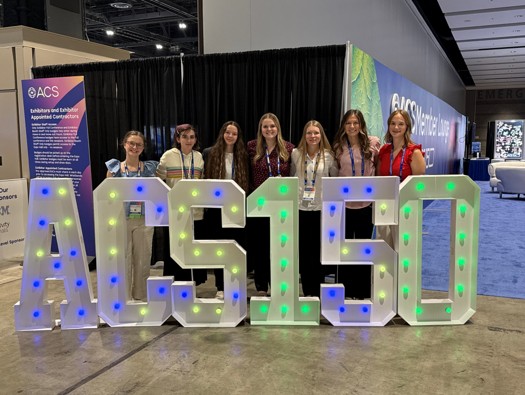
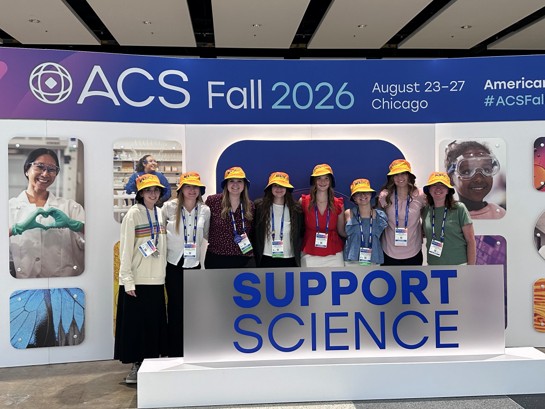
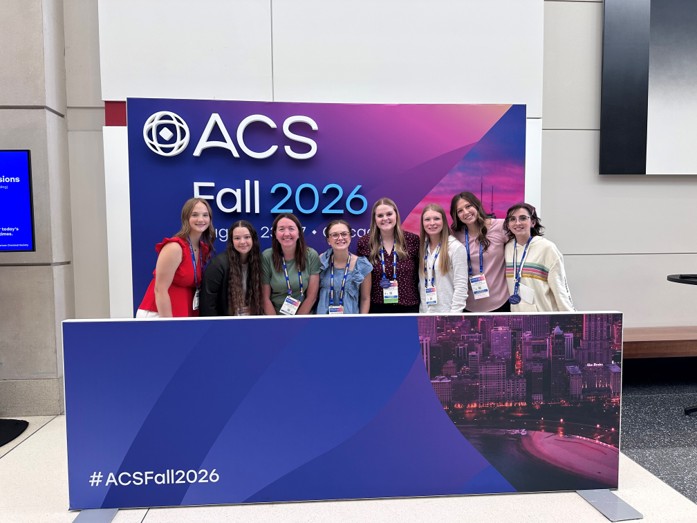
CHADRON – Three Chadron State College students – Piper Ryschon of Scottsbluff, Neb., Aubree Quast of Chadron, and Sheldyn Rodgers of Valentine, Neb. – presented posters about their original research at the American Chemical Society conference in Chicago in late August. In addition to making presentations, the students were able to learn about different and interesting research applications, according to Physical Sciences Professor and Department Chair Dr. Mary Keithly.
Other students who attended the conference are Sonya Behrends of Alliance, Neb., Margaret Teague of Casper, Wyo., Natalie Papiernik of Ord, Neb., and Piper Craig of Norfolk, Neb.
Ryschon, a senior from Scottsbluff, Nebraska, presented on the Evaluation of Zerumbone as a Gli-1 Pathway Inhibitor in Triple-negative Breast Cancer. Keithly said presenting the research was great practice for Ryschon and allowed her to network with professionals while also generating ideas for furthering her research.
Zerumbone is a natural sesquiterpenoid cyclic ketone found mainly in the rhizomes of shampoo ginger or wild ginger, known for its anti-inflammatory, antioxidant, antimicrobial, and other bioactive properties.
The question Ryschon’s research was trying to answer was if Zerumbone can successfully inhibit Hedgehog/Gli signaling and serve as a potential therapeutic candidate for triple-negative breast cancer.
“Zerumbone is a natural compound found in wild ginger. I tested Zerumbone's effectiveness on mammalian cells via viability, proliferation, and cytotoxicity assays. Along with Zerumbone, I also treated cells with Cyclopamine, which is an organic compound that is known to inhibit the Gli-1 pathway. Data was collected from both treatments and compared to determine Zerumbone's effectiveness in inhibiting triple-negative breast cancer,” Ryschon said.
Ryschon said the most interesting and useful thing she learned through her research was how to culture and maintain mammalian cells.
“Previously, I only worked with bacteria and yeast, which is much different and less time-intensive than mammalian cells,” Ryschon said.
She said it was exciting to present alongside students and researchers from other institutions.
“You learn so much from one another. Everyone is always excited to talk about their own work and share scientific ideas. It was interesting to learn from my peers how differently labs can be run and how experiments can be carried out in different ways compared to your home lab,” Ryschon said.
Ryschon said attending the conference enhanced her scientific communication skills.
“It also showed me how to collaborate with scientists in different fields to come up with new ideas for existing problems. For example, I had the honor of talking with a graduate student from the University of Illinois Urbana-Champaign,” Ryschon said. “He was intrigued by the use of organic compounds that do not resemble the shape of cholesterol. He was open to collaborating on the experiment to run a molecular dynamics simulation to see how Zerumbone is interacting with the Sonic Hedgehog pathway.”
Ryschon said the conference made an impact on her career plans.
“Prior to attending the conference, I was going to apply to a master's program in forensic science. At one of the booths at the conference, there were informational packets about a forensic science and counterterrorism research program through the FBI. I am very excited because this program offers everything I have been looking for and combines my passions of science and law enforcement,” Ryschon said.
Keithly, advisor of the Chemistry Club, said the student group has been working toward becoming affiliated with the American Chemical Society, which would give them access to additional opportunities for professional development and science outreach.
“Attending the national conference helped them learn more about the American Chemical Society and make contacts that will help our application for affiliation,” Keithly said.
Rodgers, a senior from Valentine, Nebraska, presented original research titled Next-generation biomstimulant for enhancing nitrogen use efficiency and plant physiological performance.
This research project was one that Rodgers did during a summer internship and analyzed a proprietary plant treatment for the company Redox Bio-nutrients.
Quast, a graduate student from Chadron, presented Black cumin as an antimicrobial agent: A way to combat resistant bacteria, as preliminary findings for her graduate research thesis.
Keithly said she enjoyed getting to see the students present their research and interact with professionals in the field.
“Seeing the students effectively communicating with others in the field and seeing how much they have gained while at CSC makes me very proud of them. I also loved seeing their genuine interest and engagement with others at the conference. We truly have the best students and these experiences reinforce their abilities and build their confidence,” Keithly said.
CSC students viewed poster presentations showcasing successful student chapters from schools around the world and met with representatives from the ACS Science Outreach Division. According to Keithly, the students gained ideas to strengthen CSC’s science outreach efforts and enhance local National Chemistry Week events.

Category: Physical and Life Sciences, Point of Pride, Student Awards & Achievements, Student Clubs & Organizations